Caye Caulker Snorkeling for Non-Swimmers and Kids: Ages, Safety and Which Tour
Caye Caulker snorkeling for non swimmers and kids works on most of the island's tours, and not on two of them. Life jackets and flotation are standard equipment, and licensed guides get in the water at every stop and stay close to anyone who needs the extra help. When I went through every operator's own policy for this guide, the pattern held across seven of the nine tours: children from age 4, non-swimmers welcome, calm shallow sites for the first stop. The exceptions are the Secret Beach day trip and the private full-day charter, both of which require swimmers outright. What follows is the real minimum-age table, the flotation rules, the readiness questions that matter more than a birthday, and which specific tour fits a nervous adult, a 5-year-old, or a mixed family group.
Quick answer
Yes: non-swimmers and kids from age 4 can join most Caye Caulker snorkeling tours. Every operator provides life jackets and flotation, and guides get in the water and stay near anyone who needs it. Two tours, the Secret Beach combo and the private full-day charter, require swimmers and exclude non-swimmers outright.
Key takeaways
- Most tours accept kids from age 4; the sunset-cruise half-day takes them from age 2
- Non-swimmers: fine on 7 of 9 tours with a life jacket, not fine on Secret Beach or the private charter
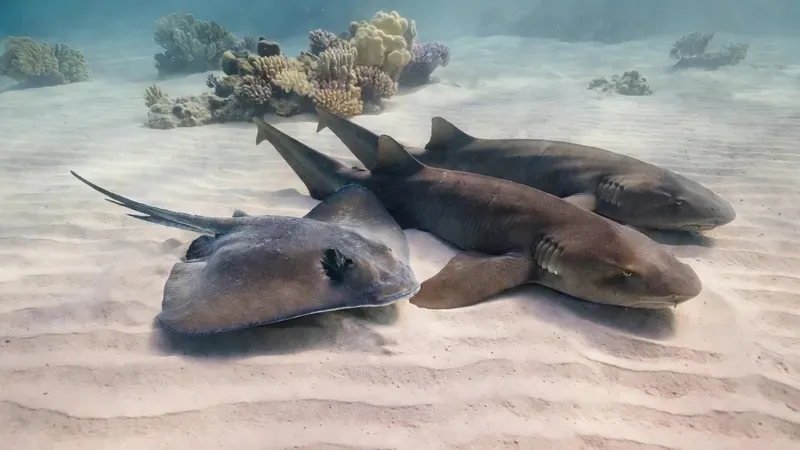
- The shark and ray stop sits 10-15 ft over a calm sandy bottom, the classic beginner site
- Full-face snorkel masks aren't recommended for young kids; operators supply standard junior masks instead
- Half-day trips (3-3.5 hours) fit a young child's attention span far better than a 6-plus-hour full day, see our half-day vs full-day comparison
- No kid discount is published on any tour's booking page; the price is the price regardless of age
Can You Snorkel If You Cannot Swim?
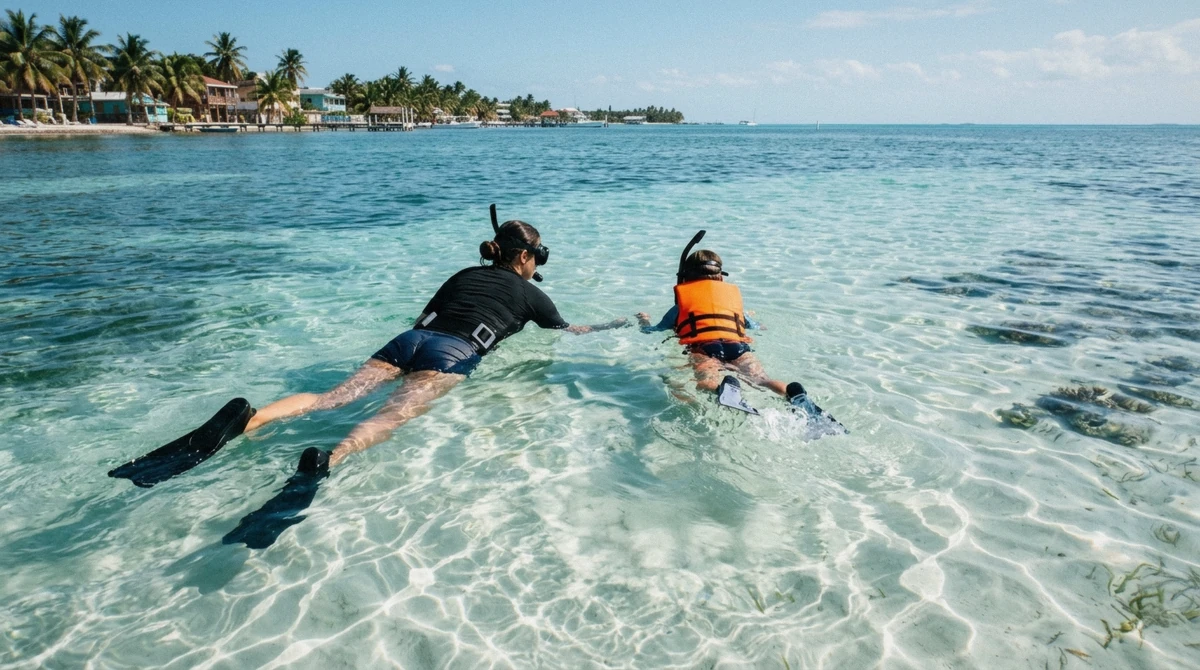
Yes, on nearly every tour this island offers. Life jackets and flotation belts are standard issue, and every operator's own guide enters the water at each stop and stays with the group rather than watching from the boat. Reviewers describe guides towing floats for nervous guests and handing over their own mask when someone's fogs up mid-stop, which is the kind of hands-on support that makes the difference for someone who has never put their face in open water before.
Basic water confidence helps: being calm floating on your back, comfortable breathing through a snorkel with your face down, not panicking if a small wave splashes over the tube. You do not need to be a strong swimmer. The shark and ray stop runs 10 to 15 feet deep over a calm sandy bottom with no current to fight, which is why nearly every operator treats it as the easiest stop for a nervous first-timer. Coral Gardens is sheltered from open-ocean swell for the same reason.
Two tours are the exceptions, and they say so plainly in their own listings. The Secret Beach combination and the private full-day charter both state they are not suitable for non-swimmers. If you or someone in your group cannot swim at all, book one of the other seven.
Minimum Ages and Restrictions
Every operator states its own restrictions in its tour listing, not a single island-wide policy. Here is what each one actually says.
- Age is checked as a self-reported detail at booking, not verified by ID at the dock
- Where a tour has no stated minimum, that means the operator's public listing does not name one; use the readiness markers below rather than assuming any age qualifies
- The two firm exclusions, non-swimmers on Secret Beach and the private charter, are policy, not a judgment call at the dock
| Tour | Minimum age / restriction | Why | Best for |
|---|---|---|---|
| Salt Life 7-Stop | No children under 4 | Long day, deeper channel stops | Families with kids 5 and up |
| Ridge & Reef from San Pedro | No children under 4, not for pregnant travelers | 7.5-hour day, four open-water stops | Families with kids 5 and up wanting free time on the island |
| Nauti Time local reef | No stated minimum age; not for pregnant travelers, back problems or mobility impairments | Getting in and out of the boat at 3 stops | Kids of any age with a confident swimmer alongside |
| Bleasean marine reserve | No stated minimum age | Small group, gentle 3.5-hour pace | Nervous swimmers and younger kids |
| Anda de Wata local reef | No stated minimum age | Shortest, flexible-start half-day | Younger kids and nervous non-swimmers |
| Secret Beach combo | Not suitable for non-swimmers | Open-water stops plus beach time | Confident swimmers only |
| Sunset cruise half-day | No children under 2 | Evening boat time, seasickness risk | Families with kids 3 and up who handle boat motion well |
| Blackhawk 6-stop | No stated minimum age; no cruise-ship passengers | Early departure, 6-hour day | Families wanting the widest stop list |
| Private full-day charter | Not suitable for non-swimmers or seasickness-prone travelers | Own-pace open-water day | Confident swimmers wanting a private boat |
Life Jackets and Flotation Rules
Every tour on this island supplies life jackets and flotation as standard gear, not an optional add-on. Think of them as an enabling tool rather than a sign something might go wrong: they are what lets a non-swimmer or a nervous kid float comfortably at the surface while looking down at the reef, hands free, with nothing to actively tread.
Guides can and do require a vest for anyone who looks unsteady in the water, regardless of what a guest requested at booking, and reviewers describe guides towing a flotation noodle for a guest the whole stop rather than leaving them to manage alone. For young kids specifically, operators use standard child-size masks, fins and vests, not the full-face masks sold online for casual snorkeling. Full-face masks are not recommended for young children because their design traps exhaled air near the nose and mouth, which can lead to a build-up of carbon dioxide in a small child's lungs; every operator here fits kids with a conventional half-mask and snorkel instead.
Is Your Child Ready? (Not Just About Age)
A stated minimum age is a floor, not a guarantee of readiness. The real gate is whether a specific child can handle a mask on their face, a stranger's instructions, and an unfamiliar wet environment without panicking, and that has more to do with temperament than birthdate.
- Can they follow a short instruction under mild stress, like 'breathe through your mouth, not your nose'? Practice this in a calm pool before the trip.
- Do they stay calm in a new, loud or wet environment, or do they need a slow warm-up? A busy tour boat is a louder, less familiar setting than a hotel pool.
- Have they shown they tolerate a mask over the face, from goggles or a bath-time dunk? A five-minute pool trial with a real snorkel mask beforehand tells you more than guessing.
- Does their attention span roughly match the tour length? A three-hour half-day suits a shorter attention span far better than six-plus hours.
- Have they handled boat motion before, on a ferry or ride, without getting sick? This matters more on the sunset cruise and the longer full-day routes.
- A child who is younger than a tour's stated minimum but seems unusually mature does not get an exception. Operators enforce their own stated age, and no amount of readiness overrides it; book a tour whose stated minimum the child actually meets.
Which Tours Fit Families and Non-Swimmers
Anda de Wata's half-day is the gentlest starting point: $55, three hours, flexible start times around weather and tides, and no stated minimum age, which makes it a reasonable first snorkel trip for a younger child alongside a confident adult swimmer.
Bleasean's marine reserve half-day runs a similarly easy pace at $70 for 3.5 hours, capped at just 10 people, so the guide has real time to work one-on-one with a nervous swimmer or a child who needs extra reassurance at the shark-and-ray stop.
Nauti Time's local reef trip suits families where every adult in the group swims confidently: it's not for pregnant travelers or anyone with back or mobility limits, since the boat makes three separate stops with three separate entries and exits.
Salt Life's 7-Stop full day is the better call for families with kids 5 and up who can commit to a longer day: it's the most-booked tour on the island, covers Hol Chan and the shark-and-ray stop plus a shipwreck and manatee territory, and includes lunch, which matters over six hours with kids.
Blackhawk's 6-stop tour starts about an hour earlier than most, so families avoid the busiest midday crowds at each stop, useful with kids who tire of waiting their turn to get in the water.
Skip the Secret Beach combo and the private charter if anyone in your group cannot swim independently; both exclude non-swimmers by policy, not preference.
Which Tour Fits Your Group
If a nervous adult non-swimmer
book Anda de Wata's half-day or Bleasean's small-group half-day; both keep the group small and the pace gentle.
If kids 4 to 8
the half-day format wins on attention span; Anda de Wata or Bleasean at 3 to 3.5 hours beat any six-hour option.
If tweens and teens
Salt Life's 7-Stop full day or Blackhawk's 6-stop tour give them more stops and more wildlife without the readiness concerns a younger sibling would have.
If a mixed family group with a non-swimmer and confident swimmers together
Bleasean's half-day keeps the group small enough for the guide to split attention between both.
If confident swimmers wanting the most ground covered
Ridge & Reef's 7.5-hour trip or the private full-day charter if the whole group swims well.
What the Tour Feels Like for a Kid
The first twenty minutes are logistics, not adventure: a gear fitting, a safety briefing, and a boat ride south that a young child experiences mostly as engine noise and wind, not excitement. That changes fast at the first stop, when a guide helps everyone into the water and a shark or stingray appears within the first few minutes; this is reliably the moment that grabs a kid's attention hardest, since it is unmistakably real and close.
Between stops, the boat ride is the part most likely to feel long to a young child, especially on a full-day tour where two or three separate rides string the stops together. Honestly: no operator's tour holds a young child's excitement uniformly across the whole duration. The shark-and-ray stop and the first coral encounter are the high points. The boat legs and the wait for lunch on a full day are the low points.
Attention Span by Age
A three-hour half-day compresses the whole trip into mostly high points, which is the practical case for choosing it over a full day with a young kid, covered in more depth in our half-day vs full-day comparison.
| Age band | Realistic focused-attention window | What that means for this trip |
|---|---|---|
| 4 to 6 | About 45 to 60 minutes of active engagement | A 3-hour half-day works; a 6-plus-hour full day runs well past their limit |
| 7 to 9 | About 90 minutes to 2 hours | Either half-day tour is comfortable; a full day is workable if the child naps or eats well beforehand |
| 10 to 12 | Close to a full adult span with a good meal on board | Full-day tours suit them, with the wait-for-lunch stretch as the one likely lull |
| 13 and up | Full adult span | Any tour on the roster fits, including the longer full-day options |
What to Pack for Kids
Operators supply the core gear: a child-size mask, fins, and a flotation vest are standard on every tour, so there's no need to buy or bring your own kit for a one-off trip. What parents should still bring or plan for:
- Reef-safe mineral sunscreen: reef-safe mineral formulas only, since chemical sunscreen is prohibited inside the marine reserve, so pack it before arriving rather than hoping to buy it dockside
- A rash guard and a hat with a chin strap: the water sits 78 to 84°F (26 to 29°C) year-round, warm enough to swim in comfortably but cool enough that kids chill faster than adults over a few hours
- A seasickness plan discussed with a pharmacist ahead of time if your child gets carsick or has never been on open water; this is not something to guess at on the dock
- Snacks and water, especially for the half-day trips, which include only fruit and water, not a full lunch
- Dry clothes for the ride back, since kids tend to get colder faster once they're out of the water and into the wind
Frequently Asked Questions
Can you join a snorkel tour if you cannot swim at all?
On most of the island's tours, yes: life jackets and flotation are provided, and guides swim with the group at every stop. Two tours, the Secret Beach combo and the private full-day charter, require swimmers and exclude non-swimmers outright.
What is the youngest age a child can go snorkeling on Caye Caulker?
Most operators set no stated minimum on the shorter half-day tours, while the fuller-day tours cluster around age 4. The sunset cruise half-day takes children from age 2, though it isn't a fit for anyone prone to seasickness.
Are full-face snorkel masks safe for kids?
They aren't recommended for young children, since their design can trap exhaled air near the nose and mouth and lead to a carbon dioxide build-up in small lungs. Every operator on this island fits kids with a standard half-mask and snorkel instead.
How long can a young child actually stay engaged on a snorkel tour?
Realistically, the length of a half-day: three to three-and-a-half hours. A six-plus-hour full day usually holds a young child's interest through the first two stops, then the boat legs and the lunch wait start to feel long.
Do kids get a discount on Caye Caulker snorkel tours?
No published kid pricing exists on any of these tours' booking pages. The listed price applies regardless of age, so budget the full adult rate for every seat.
What happens if my child gets scared or wants out partway through a stop?
Guides stay in the water with the group and can bring a guest back to the boat early if needed; nobody is required to stay in the water for the full stop. The small group caps on most tours (10 to 15 people) mean a guide can realistically respond to one guest needing extra help.
Is the shark and ray stop safe for a nervous swimmer or child?
It's widely treated as the easiest stop on the island: 10 to 15 feet deep over a calm sandy bottom with no current, which is why nearly every tour uses it as an early, confidence-building stop. See our full shark and ray guide for more detail.